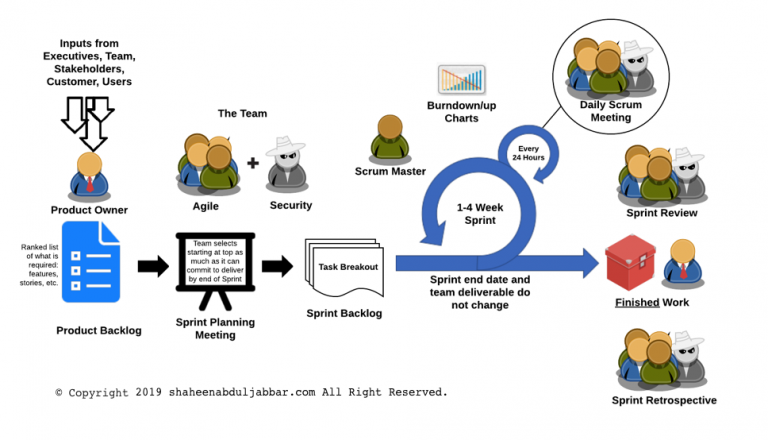
Many large organizations are moving towards the Agile software development lifecycle (SDLC) methodology. Agile methodology is a combination of iterative and incremental process models with a focus on process adaptability and customer satisfaction by rapid delivery of working software product. The general characteristics of any Agile methodology are: Prioritizing feedback. Agile teams rely heavily on the… Continue reading Security in Agile Methodology
Category: Risk Management
Security Management Practices
Information Security Risk Analysis (ISRA)
The ISRA methodology is used by a system designer, manager, or security analyst to identify security concerns, develop an action plan, analyze costs, and assign responsibilities. The process allows a facilitator to perform a subjective risk assessment on a particular system, application, or other corporate assets. The ISRA involves the system users from the very… Continue reading Information Security Risk Analysis (ISRA)
Facilitated Risk Analysis and Assessment Process (FRAAP)
FRAAP is a structured approach to an accelerated assessment of each component of a system within a short timeframe. It is consistent with the National Institute of Standards and Technology October 2001 Special Publication “Risk Management Guide of Information Technology Systems” and the FFIEC December 2002 “Information Security Risk Assessment.” The approach allows us to… Continue reading Facilitated Risk Analysis and Assessment Process (FRAAP)
Best of Breed or Best Suite of Products
Should organizations implement layered defenses from different vendors? Should we rely upon a single vendor for an organization’s overall security? According to a Gartner research paper, “Two firewall platforms are not better than one. We believe there is a higher risk associated with configuring and managing firewalls from multiple vendors than from a single vendor.… Continue reading Best of Breed or Best Suite of Products
Acknowledging Non-Applicable Threats
Is it important to account for or acknowledge risks that may not apply to an organization or system? What if you identified a risk that you would typically consider for but would not use due because of the context. Say, for example, your organization is not in a floodplain however it is usual to consider… Continue reading Acknowledging Non-Applicable Threats